- news
Tuesday, 20th January 2026
Unlocking the Power of Data: How Law Centres are Putting Data to Work for Justice
Alex Charles, Head of IT and Data, Law Centres Network
January 2026
As we step into 2026, the importance of good data in the justice sector has never been clearer. Across the country, Law Centres continue to meet rising demand in communities facing increasingly complex legal needs. Yet despite their impact, much of the story of legal help and representation remains under told, fragmented across dozens of systems, formats and reporting requirements. Last year, we at the Law Centres Network set out to change that.
Why data has become central to our work
Recent parliamentary scrutiny has highlighted how difficult it remains to understand, at a national level, where people can still access face-to-face legal advice, and where provision has fallen away, particularly in areas such as housing and debt. A decade on from major legal aid reforms, significant gaps persist, yet the evidence needed to describe them clearly and consistently is still fragmented.
For us as a Network, that context reinforces why shared, community-rooted data matters. For Law Centres, data is ultimately about people. Law Centres hold insights that rarely appear in national datasets: not only who is helped, but who is turned away, where demand goes unmet, and how problems escalate when early advice is unavailable. Bringing that evidence together is essential if funding and policy decisions are to reflect the realities on the ground.
Throughout 2025, the Network and several Centres of Excellence* worked together towards that aim. What emerged was a renewed sense of shared purpose: a recognition that while our Centres face different challenges locally, many of our data issues are universal. And when we work to solve them together, the benefits ripple far beyond any single organisation.
What we achieved in 2025
The year was marked by a level of engagement and collaboration that reflects just how ready the Network is to move forward. More than 37 Law Centres and 18 Centres of Excellence took part in research, consultations, workshops and training. We saw growing participation in communities of practice, and the launch of a regular data and digital bulletin helped keep colleagues connected and informed.
On the ground, Centres invested heavily in skills. We ran more than 20 practical training sessions covering everything from Excel and reporting to data storytelling and data governance. Our first Data Leaders Course brought managers together to explore how to build stronger data culture and strategy. And our Data Apprenticeship Programme grew to 16 apprentices across 13 organisations, many of whom are already making their mark by improving internal processes, strengthening reporting, and freeing up staff time.
Behind the scenes, we deepened our understanding of the Network’s data landscape through a major data mapping exercise and a full Network-wide data maturity assessment. We learned what data Centres collect, how it is used, where systems differ, and where the biggest opportunities lie. We also continued to strengthen the foundations for good governance and security, with over 20 Centres achieving or working toward Cyber Essentials.
Taken together, these achievements signalled more than progress; they showed a shift in mindset. Across the Network, data began to be seen not as a burden, but as a tool for improving services, amplifying voice and shaping a fairer system.
The Common Data Framework: a foundation for a stronger sector
The most ambitious part of the work last year was the progress we made on building a Common Data Framework. For decades, the advice and legal support sector has operated without a shared language: different definitions of “client”, “case”, “outcome”; different categories for demographic and outcomes data; different expectations from funders; and systems that don’t speak to one another.
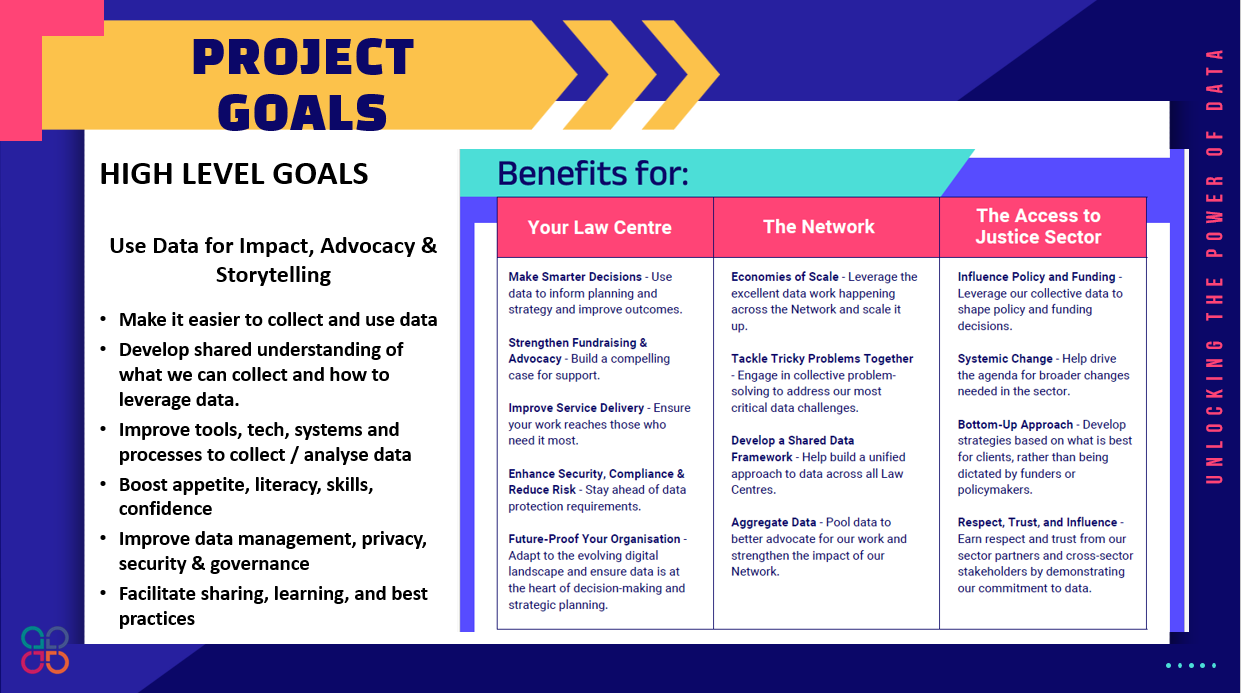
Throughout 2025, we set out to change this, not by imposing a standard, but by co-designing one with the Network and our partners in the wider advice sector. Through workshops, surveys, consultations and document review, we began shaping a shared approach to the core data items that matter most across the client journey: who people are, what support they sought, how they were helped, and what difference that help made.
The Framework is being built for flexibility, recognising the realities of frontline work, uneven capacity, and the diversity of our Centres. Its purpose is ambitious but pragmatic: to make data more comparable, more consistent, and more meaningful across the Network, where Centres choose to adopt shared definitions and minimum datasets.
That matters not only for us, but for the wider sector, including our work with national partners such as the Ministry of Justice on its Outcomes Framework.
What we learned on the journey
The work has taught us that Centres need clarity, simplicity and ongoing support to make data improvements stick. It has also reinforced how much appetite there is for shared solutions, and how isolating it has been for Centres to navigate data challenges alone. By coming together, we have seen that many of our issues mirror each other: inconsistent reporting categories, system limitations, time pressures, staff confidence, and the need to balance funder requirements with meaningful practice.
Most importantly, we learned that progress is possible even when capacity is stretched, and that change is far easier when it is done collectively.
Looking to 2026: from design to delivery
This year marks the beginning of the implementation phase. Our focus now is on refining, testing and introducing the Common Data Framework with a small pilot of Centres. We will work with early adopters to pilot the Framework, build guidance and examples, iterate based on real-world use, and support Centres as they begin adopting shared definitions and minimum datasets.
We will ramp up training, including sessions on Excel, Power BI, making the most of legal CMSs like AdvicePro, data storytelling, building data culture and more. We will continue to strengthen communities of practice, bringing Law Centres together to share and learn from each other. We will deepen our work with funders, policymakers and national bodies, and continue championing the importance of community-rooted legal data in shaping policy, influencing commissioning and demonstrating impact.
Where this work leads us
The journey ahead is both technical and transformational and will be shaped by what we learn along the way. Ultimately, the Common Data Framework is not just about data, it’s about the future of access to justice. It’s about enabling a stronger collective voice, ensuring that evidence reflects the realities of our communities, and making it easier for Law Centres to show the value of their work.
We are proud of what we achieved in 2025, and even more focused on what lies ahead. In 2026, we will take the next steps together: building a shared foundation that supports better services, stronger advocacy, and more informed decision-making across the justice system.
For More Info
Contact: Alex Charles | alex@lawcentres.org.uk
*Centres of Excellence are charitable organisations working in the free social welfare legal advice sector across London and the South East, and supported and part-funded by London Legal Support Trust.
Latest News
Tuesday, 7th July 2026
High Court judgment reinforces councils' duty to support homeless disabled peopleWednesday, 6th May 2026
Hillingdon Law Centre temporary closure: our statementWednesday, 22nd April 2026
The BBC investigation, the broken asylum system, and the view from Law Centres
Stay in the loop
Sign up for our monthly newsletter to stay in the loop